
Automate document workflows
I build custom solutions that capture, understand, validate and process PDFs, forms, emails and other business documents — then connect the results to the systems and workflows your team already uses.
When documents keep creating manual work
The information already exists — but someone still has to read it, copy it into another system, validate it and move the process forward.
Open and review documents
PDFs, forms and email attachments are opened manually, reviewed and sorted before anything else can happen.
Transfer information
Relevant values are searched for, copied and entered into another application, spreadsheet or internal system.
Validate and route
Data is checked, documents are stored or forwarded, and follow-up tasks are triggered manually.
What can be automated
Not every step needs AI. In many cases, the most reliable solution combines solid software engineering, OCR, deterministic rules, APIs and carefully selected AI models.
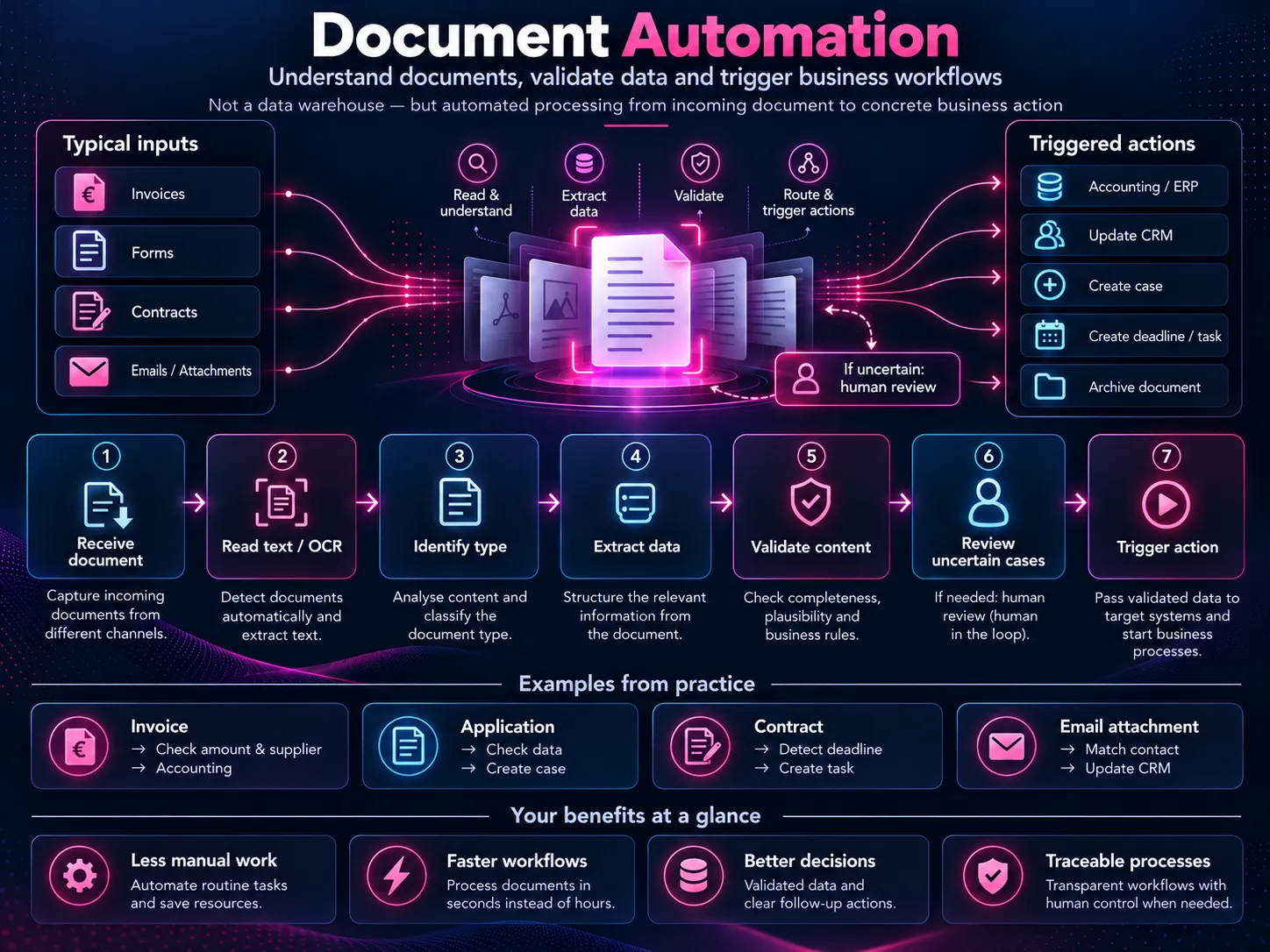
From incoming document to automated action
Document automation is not just about extracting text from a PDF. The document is identified, relevant information is extracted and validated, uncertain cases can be reviewed by a person, and the result triggers a concrete business action.
Extend existing systems instead of creating another silo
If your existing applications already work, there is no reason to replace them unnecessarily. Document automation can add intelligent processing steps to the infrastructure you already use.
The goal is not to use as much AI as possible. The goal is a reliable, understandable and maintainable workflow.
Typical integration points
Start with one real workflow
Document automation does not need to begin as a large transformation project. One recurring document type or one clearly defined workflow is often the better starting point.
Understand the documents
Which documents arrive, in what format and quality, and through which channels?
Define the information you need
Which fields and facts matter, and which business rules need to be applied?
Define the target system
Where should the validated information go, and which cases should still be reviewed by a person?
Test with real examples
Build and validate the first workflow using representative documents, then extend it where it creates real value.
Backend engineering, integration and automation
Custom software development for document workflows that need to work reliably inside real business systems.
Is a document-heavy process creating too much manual work?
I can review how the process works today and identify which parts can be automated effectively. You do not need a finished specification — one real workflow and a few representative documents are often enough for an initial conversation.
Get in touch →